
Some cities you visit once and forget. Agra is not one of them. This Agra travel guide exists because too many visitors rush through this city, tick the Taj Mahal off their list, and leave before the afternoon light has even had a chance to shift. What they miss — the quiet corners, the real food, the layers of Mughal history just sitting there waiting — is often better than the postcard version they came for.
Whether you are arriving from Delhi on the Gatimaan Express, wrapping up a Golden Triangle Tour, or planning your first trip to India and wondering where to start — this guide covers everything you need. Best time to visit, top monuments, where to eat, how to get around, what to avoid, and why Agra deserves at least two full days of your time.
Let us start from the beginning.
Why Agra Deserves More Than One Day
Most itineraries treat Agra as a single-day stop. You come for the Taj Mahal, which is understandable — it is one of the most extraordinary buildings in the world. But reducing Agra to one monument is like visiting Rome just for the Colosseum and skipping everything else.
The city sits in Uttar Pradesh, about 230 kilometres south of Delhi. Beyond the Taj Mahal, it holds Agra Fort — a massive red sandstone palace-fortress that spans centuries of Mughal history. It has the Itmad-ud-Daulah, a small but breathtaking marble tomb known as the Baby Taj. And about 40 kilometres away lies Fatehpur Sikri, Akbar’s abandoned Mughal capital — a ghost city that most tourists skip and almost everyone who visits considers the highlight of the trip.
One day gives you the Taj Mahal. Two days gives you Agra. Three days gives you the full story.
The Story Behind the Taj Mahal (That Most Tour Guides Rush Through)
Emperor Shah Jahan built the Taj Mahal between 1632 and 1653 as a tomb for his wife Mumtaz Mahal, who died during childbirth — their fourteenth child. More than 20,000 workers and artisans came from across Central Asia and India. The white marble was sourced from Makrana in Rajasthan. The semi-precious stones inlaid in the walls — lapis lazuli, turquoise, jade, coral — were imported from Russia, Afghanistan, and China.
What most visitors never hear: Shah Jahan spent his final years imprisoned inside Agra Fort by his own son Aurangzeb. From a small tower window called the Musamman Burj, he could see the Taj Mahal across the Yamuna river every single day. He was eventually buried beside his wife.
That one detail changes everything about how you look at that building.
Best Time to Visit — This Agra Travel Guide’s Most Important Section
Agra in the wrong season is genuinely uncomfortable. Getting the timing right makes an enormous difference to your experience.
October to March — Peak Season for Good Reason
Temperatures stay between 8°C and 25°C. Mornings carry a slight chill, afternoons are pleasant, and the light during sunrise and sunset makes the Taj Mahal glow in ways that photographs simply cannot capture. December and January sometimes bring morning fog, which many travellers actually love — it gives the monument a soft, dreamlike quality that feels almost otherworldly.
If you are planning a broader India trip and want to understand seasonal patterns across the country, the Rajasthan Heritage Tours guide on this site also covers the winter travel season in detail.
April to June — Hot and Honest
Temperatures regularly cross 44°C. Exploring outdoor monuments in this heat is genuinely unpleasant. If this is your only available window, arrive before 8 AM and be back at your hotel by 10.
July to September — Monsoon Season
Humidity is high, but crowds thin significantly and hotel rates drop. The Taj Mahal framed by dramatic monsoon clouds makes for some of the most striking photographs you will ever take. Some travellers actively prefer this season precisely because of the solitude it offers.

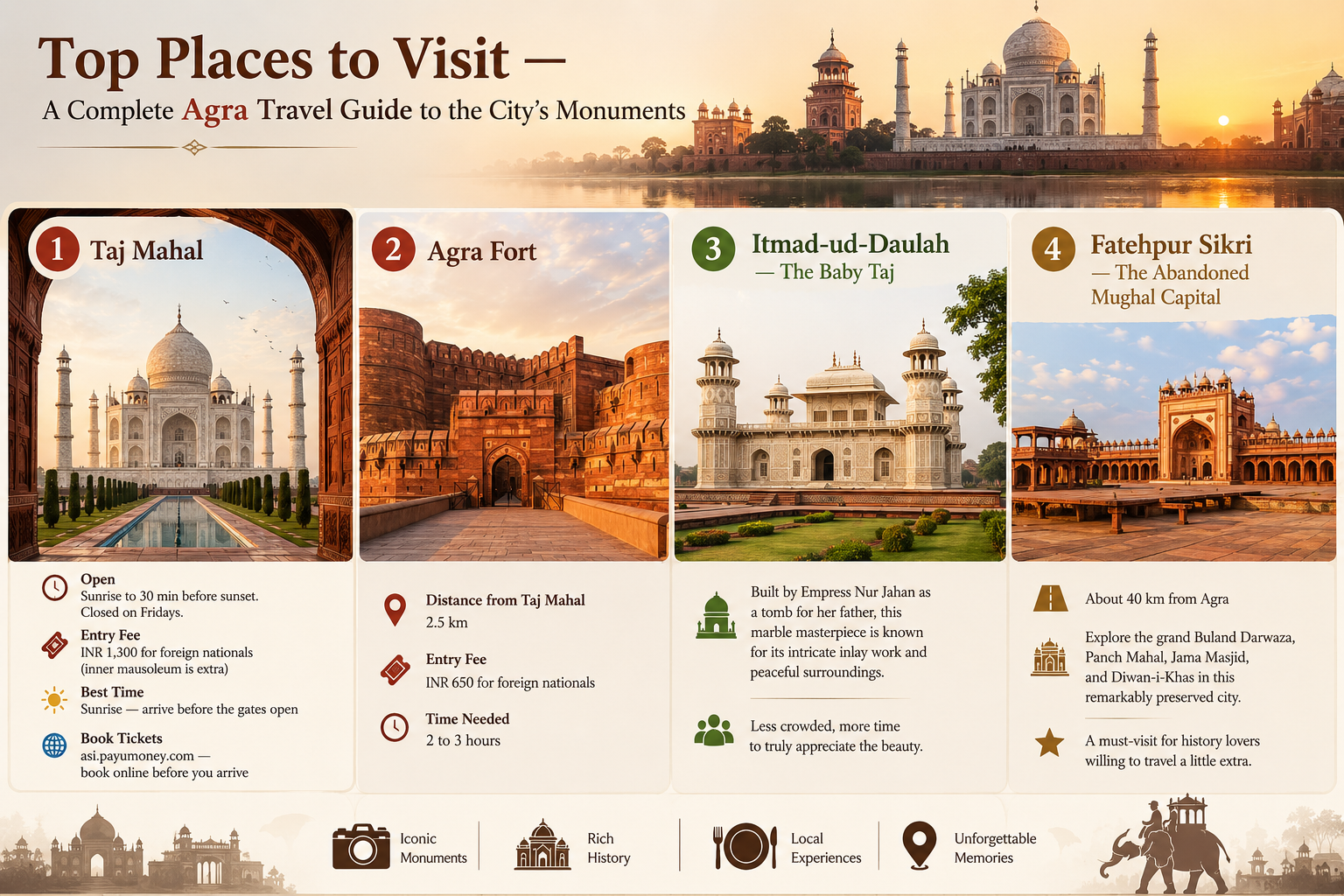
Top Places to Visit — A Complete Agra Travel Guide to the City’s Monuments
1. Taj Mahal
| Open | Sunrise to 30 min before sunset. Closed on Fridays. |
| Entry Fee | INR 1,300 for foreign nationals (inner mausoleum is extra) |
| Best Time | Sunrise — arrive before the gates open |
| Book Tickets | asi.payumoney.com — book online before you arrive |
The queue at the east gate opens before sunrise. Getting here early is the single best decision you can make in Agra. The Taj Mahal in soft morning light — with mist sitting over the Yamuna behind it and almost no one else around — is a completely different experience from the midday version. By 9 AM the crowds build. By 10 AM you are navigating a sea of tour groups just to get close to the entrance.
Give yourself at least two hours inside. More, if you want to sit quietly and let the place settle around you.
2. Agra Fort
|
Distance from Taj Mahal |
2.5 km |
|---|---|
|
Entry Fee |
INR 650 for foreign nationals |
| Time Needed | 2 to 3 hours |
Agra Fort is treated as an afterthought by most visitors. It should not be. Built initially by Emperor Akbar in 1565 and later expanded by Jahangir and Shah Jahan, this red sandstone complex served as both a military stronghold and a royal palace. The Diwan-i-Khas, Jahangir’s Palace, and the Musamman Burj — the tower where Shah Jahan looked out at the Taj Mahal during his imprisonment — are all within the complex.
The fort also offers a distant view of the Taj Mahal across the Yamuna river. Standing in Shah Jahan’s place and looking out at that view is one of those quiet, affecting travel moments that no guide can prepare you for.
3. Itmad-ud-Daulah — The Baby Taj
Built by Empress Nur Jahan as a tomb for her father, the Itmad-ud-Daulah sits on the east bank of the Yamuna. It is considered the architectural stepping stone between the earlier red sandstone Mughal style and the white marble perfection of the Taj Mahal. The inlay work here is extraordinarily fine — perhaps more detailed, in certain corners, than the Taj itself.
It is also far less crowded. You can actually stand and look at things without being pushed along by a tour group.
4. Fatehpur Sikri — The Abandoned Mughal Capital
About 40 kilometres from Agra, Fatehpur Sikri is the city that Emperor Akbar built as his imperial capital and then left behind — reportedly because of a chronic water shortage. Today it stands in remarkable condition. The Buland Darwaza, the Panch Mahal, the Jama Masjid, and the ornate Diwan-i-Khas within the complex are all worth extended exploration.
Most tourists skip this site because of the extra travel time. That is a mistake worth avoiding.
Where to Eat in Agra — Local Food Worth Seeking Out
Must-Try Food in Agra
Petha is Agra’s most famous product — a translucent sweet made from ash gourd, available in flavours like kesar, angoori, and rose. Panchhi Petha, a shop operating since 1956, is the most trusted place to buy it. Their boxes make excellent carry-home gifts and are easy to find near the main market.
For full meals, Pinch of Spice on Fatehabad Road is consistently well-reviewed by both Indian and foreign visitors and serves solid North Indian food at mid-range prices. For something more local and budget-friendly, the thali restaurants in the lanes near Sadar Bazaar offer generous meals — dal, sabzi, fresh rotis — for under INR 150.
A Note on Roadside Food Near Monuments
Street food near the Taj Mahal east gate varies in quality. Stick to busy stalls with fast turnover — freshly made aloo tikki, hot jalebi, and properly brewed chai are almost always safe choices. Avoid anything involving standing water or pre-cooked items sitting in the open.
How to Get to Agra
By Train — The Best Option for Most Visitors
The Gatimaan Express from Hazrat Nizamuddin station in Delhi reaches Agra Cantt in approximately 100 minutes — one of the fastest and most comfortable ways to arrive. The Shatabdi Express is another reliable choice. Book through IRCTC well in advance. Seats on the Gatimaan fill up quickly between October and February.
By Road
Agra sits along the Yamuna Expressway, roughly 230 kilometres from Delhi. The drive takes between three and four hours depending on traffic. Taxis and hired cabs are widely used by travellers on self-planned trips. If you are already on a Golden Triangle itinerary, the road leg is typically included in your arrangement.
Booking Tip for Foreign Tourists
Book your Taj Mahal entry tickets online through the Archaeological Survey of India website before arriving in Agra. During peak winter weekends and public holidays, tickets sell out. There is no reason to travel this far only to discover that entry is unavailable on the day.
Practical Tips for Your Visit
- Photography: Tripods are not allowed inside the Taj Mahal complex. Your phone camera is completely fine.
- Dress code: Cover shoulders and knees before entering any monument. A lightweight scarf takes up almost no space and saves you from renting one at the gate.
- Guided tours: Official ASI-certified guides are available at monument entrances for approximately INR 500 to 800. For first-time visitors at the Taj Mahal, a good guide is money well spent.
- Currency: Carry cash. Many smaller shops, food stalls, and vendors near monuments do not accept cards or UPI.
- The closed monument scam: If someone on the street tells you the Taj Mahal is “closed today” and offers to take you to a government shop instead, it is not true. Walk away.
- Footwear: You will remove your shoes at the Taj Mahal main gate. Wear something easy to slip on and off. The shoe-check counter is free.
How Many Days Do You Need in Agra?
Short on time — one day: Taj Mahal at sunrise, Agra Fort by midday, Itmad-ud-Daulah in the afternoon. Tight but doable.
More flexibility — two days: Add Fatehpur Sikri on day two. Take an evening walk through Sadar Bazaar. Eat properly.
Unhurried — three days: Revisit the Taj Mahal at sunset. Explore the back lanes of the city. Try a local cooking class or craft workshop.
Final Thoughts
Agra is built around a single monument, but it is more than that monument. The city has weight to it — history that feels immediate, food worth seeking out, and quieter corners that most travellers never reach because they have already moved on to the next destination.
Use this Agra travel guide as your starting point, whether you are planning one day or a full week. For broader India planning, our India travel cost guide for foreigners and India safety guide for tourists cover the practical questions that come up when you start building your itinerary.
Whatever this Agra travel guide helps you plan — the rest, as always, is yours to discover on the ground.