
Best Time to Visit Rajasthan:
Complete Season-by-Season Guide
Honest, practical advice on when to go — by weather, festivals, crowd levels, and budget. Updated for 2025–26.
Imagine riding a camel at sunset, watching the Thar Desert blush from amber to deep violet. Behind you, a 16th-century fort glows in the dying light. This is Rajasthan — and every season dresses it differently.
The best time to visit Rajasthan isn't the same for everyone. A photographer chasing golden dunes will give different advice than a festival-goer or a wildlife enthusiast. This guide breaks down exactly what each season offers — temperature, crowds, festivals, prices, and all the nuances a generic weather page won't tell you.
Rajasthan is India's largest state, covering over 340,000 sq km. Its landscape shifts from bone-dry desert in the west to green-tinged hills in the east. The people, the food, the colors — all of it changes with the seasons. Let's find out which season is yours.
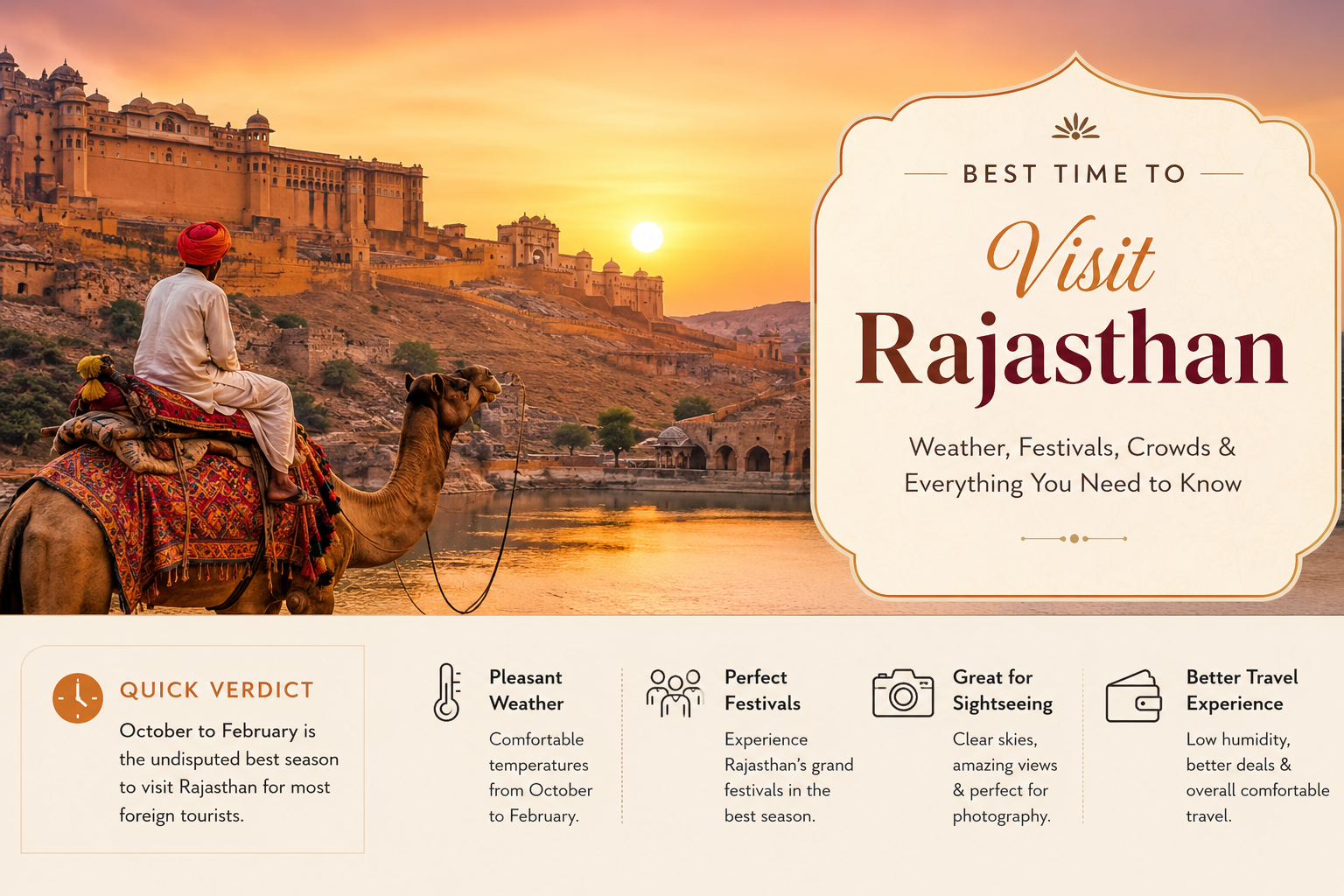
October to February is the undisputed best season to visit Rajasthan for most foreign tourists — comfortable temperatures, low humidity, and peak festival season. But if you know what you're doing, even July and June have their magic.
Rajasthan Weather by Season
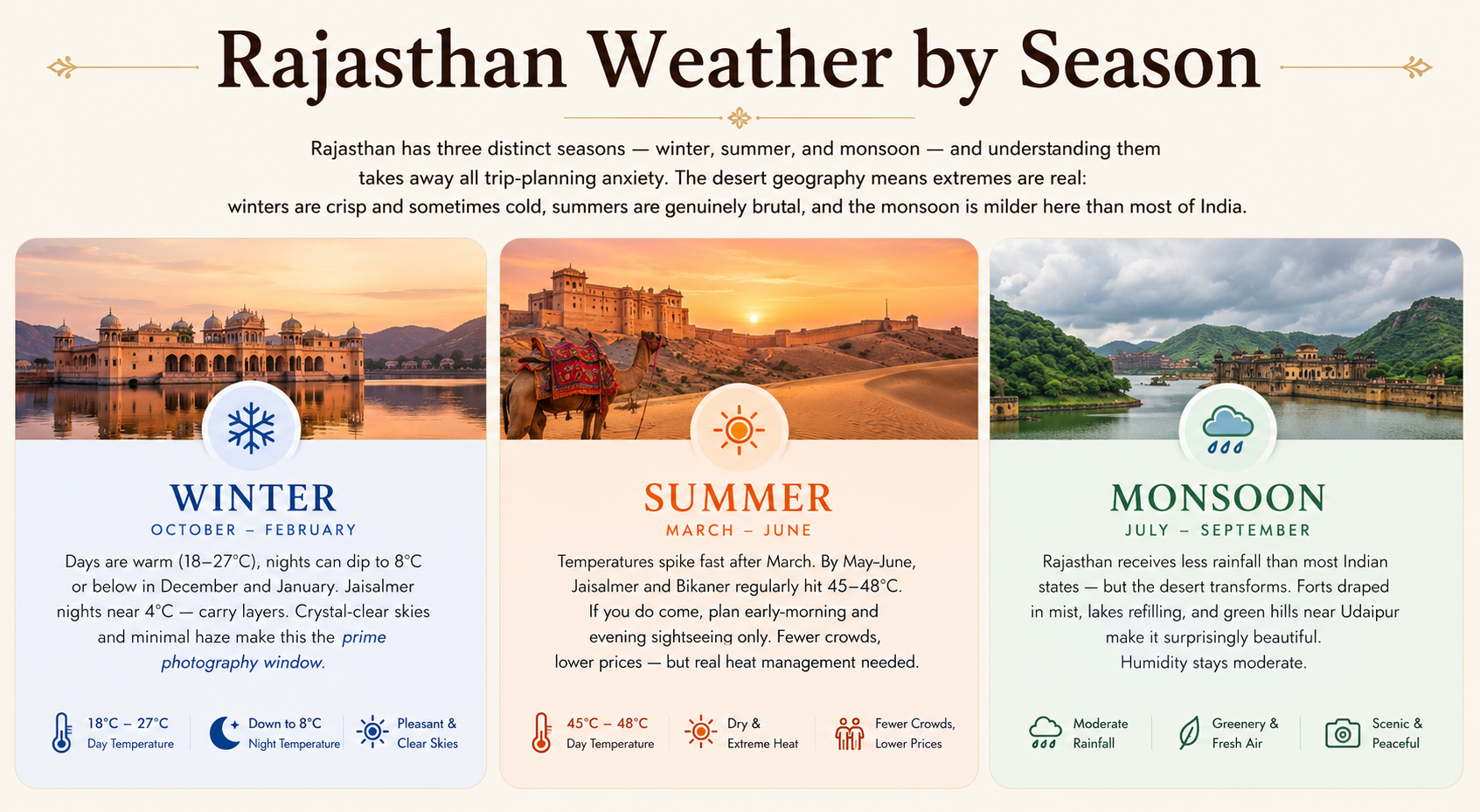
Rajasthan has three distinct seasons — winter, summer, and monsoon — and understanding them takes away all trip-planning anxiety. The desert geography means extremes are real: winters are crisp and sometimes cold, summers are genuinely brutal, and the monsoon is milder here than most of India.
Days are warm (18–27°C), nights can dip to 8°C or below in December and January. Crystal-clear skies make this the prime photography window.
Temperatures spike fast after March. By May–June, Jaisalmer and Bikaner hit 45–48°C. Fewer crowds, lower prices — but real heat management needed.
Rajasthan receives less rainfall than most Indian states — but the desert transforms. Forts draped in mist, lakes refilling, and green hills near Udaipur.
Winter in Rajasthan: The Golden Window
If Rajasthan has a golden hour, it lasts from October to February. This is when the state shows its finest face — blue skies, crisp air, and a festive energy that is impossible to replicate any other time of year.
October and November ease you in gently. Temperatures are pleasant through the day (22–28°C) and cooler at night. Diwali — the festival of lights — usually falls here, and watching Jaipur or Udaipur celebrate Diwali is something that rewires the senses.
December and January are the coldest months. Desert nights are sharply cold — below 5°C in Jaisalmer on some nights — so packing a proper jacket is not optional. But daytime is ideal for fort walks, bazaar wandering, and jeep safaris in Ranthambore. This is also the peak tourist season, so book accommodation early, especially for heritage hotels and Haveli.
February is arguably the single best month to visit Rajasthan. The temperature is perfect — not cold enough to limit activities, not warm enough to exhaust you. And it hosts the Jaipur Literature Festival, one of the world's largest free literary gatherings.
- Ideal sightseeing temperatures
- Clear skies for photography
- Camel and desert safaris in full swing
- Rich festival calendar
- Peak birdwatching at Bharatpur
- All roads and sites accessible
- Highest hotel prices of the year
- Advance booking is essential
- Popular sites get crowded
- Cold desert nights (pack layers)
- Air fares peak during December
Summer in Rajasthan: For the Bold Traveller
Summer in Rajasthan is not for the faint of heart — and that's exactly why some seasoned travelers prefer it. You'll have the forts largely to yourself. Prices drop by 30–50%. Hoteliers will negotiate. The same Amer Fort that draws 6,000 visitors on a winter Saturday might have a few hundred in May.
However, let's be honest: temperatures between 42°C and 48°C are hostile. Outdoor sightseeing after 9am is genuinely uncomfortable. The practical strategy is to start at dawn, retreat to your hotel by 11am, and venture out again after 5pm. Most premium heritage properties have excellent pools — use them.
If you're on a budget and willing to adjust your schedule to the sun, summer offers Rajasthan's best value. Stay in havelis and boutique properties — many run off-season deals of up to 60% off peak rates. Late evenings at rooftop restaurants become the highlight of the day.
Monsoon in Rajasthan: The Overlooked Season
Most travel guides dismiss Rajasthan's monsoon. That's a mistake — at least for Udaipur, Mount Abu, and Kota. The southeastern part of Rajasthan receives meaningful rainfall, and the result is genuinely stunning: waterfalls reappear on dry cliffs, the Aravalli hills go green, and Lake Pichola in Udaipur fills to the brim.
Western Rajasthan — Jaisalmer, Barmer, Bikaner — receives very little rain, so the desert retains its character while everything feels slightly cooler. It's not a bad time to visit these cities if monsoon atmosphere is your goal.
The main caveat: some rural roads become difficult, and Ranthambore National Park closes from July to October. Plan around those limitations and the monsoon rewards you with a Rajasthan that most tourists have never seen.
Best Months to Visit Rajasthan — At a Glance
| Month | Avg. Temp | Rainfall | Crowds | Verdict |
|---|---|---|---|---|
| October | 22–32°C | Very low | Moderate | Excellent |
| November | 17–28°C | None | High | Excellent |
| December | 8–22°C | None | Peak | Excellent |
| January | 6–20°C | Rare | Peak | Excellent |
| February | 10–25°C | None | High | Best Overall |
| March | 15–30°C | None | Moderate | Good |
| April | 22–38°C | None | Low | Manageable |
| May | 28–44°C | None | Very Low | Hot, plan carefully |
| June | 30–46°C | Very low | Very Low | Not recommended |
| July | 25–38°C | Moderate | Very Low | Udaipur only |
| August | 24–36°C | Moderate | Low | Scenic southeast |
| September | 23–34°C | Low | Low | Improving |
Best Time for Festivals in Rajasthan
Rajasthan doesn't celebrate festivals — it inhabits them. The desert turns into a canvas of color, music, and ceremony every few weeks between October and March. If you can align your trip with even one major festival, do it.
-
Oct–Nov Diwali
Diwali — Festival of Lights
Entire cities lit with oil lamps and fireworks. Jaipur and Jodhpur are exceptional during this time. Streets transform into rivers of light.
-
Nov Pushkar
Pushkar Camel Fair
One of the world's greatest cultural spectacles — over 50,000 camels, folk music, acrobatics, and ancient religious rituals at the sacred lake.
-
Jan Jaipur
Jaipur Literature Festival
The world's largest free literary festival draws Nobel laureates, Booker winners, and 400,000+ visitors over five days. A unique cultural experience.
-
Jan Jaisalmer
Desert Festival, Jaisalmer
Three days of camel races, folk dances, turban-tying contests, and Mr. Desert competitions — set against the dramatic Thar dunes.
-
Mar Holi
Holi — Festival of Colors
Celebrated with unmatched energy in Rajasthan. The celebration in Jaipur's old city and in Barsana-style folk traditions is unforgettable.
-
Apr Gangaur
Gangaur Festival
Rajasthan's most beloved local festival — women in elaborate traditional dress carry clay idols of Goddess Gauri in processions through the old cities.
Best Cities to Visit by Season
Different seasons reveal different sides of Rajasthan's major cities. Here's where to head depending on when you arrive:
During Winter (Oct – Feb)
Desert safaris, dune camping, and the Desert Festival in January.
Amer Fort, city palace, bazaars — all at their best in winter light.
The blue city and Mehrangarh Fort are magical in clear winter skies.
Best tiger sightings happen Oct–Feb before summer closes water holes.
During Monsoon (Jul – Sep)
Lake Pichola fills up. The City Palace's reflection on the water is breathtaking.
Rajasthan's only hill station gets lush and misty — a cool retreat.
Chambal River and surrounding greenery looks best after monsoon rains.
Travel Tips for Foreign Tourists in Rajasthan
Rajasthan is one of India's most tourist-friendly states, but a few smart moves make the difference between a good trip and a flawless one.
Pack for Layers
Even in peak winter, days can reach 28°C while nights drop below 8°C. Especially in Jaisalmer, a proper jacket is non-negotiable after dark.
Book Heritage Hotels Early
The best havelis and palace hotels — Samode, Raas, Taj Rambagh — fill up months ahead in peak season. Book at least 60–90 days out.
Hire a Private Driver
A private car with driver for 7–10 days gives you the freedom to stop at step wells, roadside dhaba restaurants, and unmarked viewpoints without compromise.
Hydration Is Strategic
Even in winter, desert air is dry. In summer, dehydration sneaks up fast. Carry water always and add electrolytes to your kit.
Go Offline Intentionally
Some of Rajasthan's finest moments happen when you put the phone down — especially at dawn over the dunes or in a village market in Barmer.
Chase Golden Hour
The light in Rajasthan at 6am and 6pm is extraordinary — especially at Jaisalmer's Sam Dunes, Jodhpur's Mehrangarh, and Chittorgarh Fort.
Frequently Asked Questions
Honest answers — no filler.
Which month is the absolute best to visit Rajasthan?
February is the single best month for most international travellers. Temperatures sit between 10–25°C — perfect for outdoor sightseeing from dawn to dusk. It also hosts the Jaipur Literature Festival. October and November are close seconds with equally good weather and fewer crowds than December–January.
Is Rajasthan too hot to visit in summer?
Bluntly: May and June are harsh. 44–48°C is not a comfortable outdoor temperature for anyone. That said, experienced budget travellers visit in summer by adjusting their schedule — sightseeing only at 6–10am and 5–7pm, spending midday in cool havelis or pools. Not recommended for first-time visitors or those with children.
Is Rajasthan safe for foreign tourists?
Yes — Rajasthan is consistently ranked among India's safest states for tourists. Major cities have tourist police. Solo women travellers visit regularly and report positive experiences, though standard awareness applies everywhere. The main irritant is persistent sales pressure in bazaars, not safety threats.
How many days should I spend in Rajasthan?
For a proper Golden Triangle extension (Jaipur + one more city): 4–5 days. For the classic Rajasthan circuit (Jaipur, Jodhpur, Jaisalmer, Udaipur): 10–12 days. For a deep dive that includes Ranthambore, Pushkar, Bikaner, and Chittorgarh: 14–16 days. Don't rush. Rajasthan rewards slowness.
What should I pack for a Rajasthan trip in winter?
Layered clothing is the key — light cotton for daytime, a fleece or down jacket for evenings. A pashmina-style shawl doubles as warmth and cultural respect at temples. Add comfortable walking shoes (fort paths are uneven), sunscreen, and a reusable water bottle.
What is the cheapest time to visit Rajasthan?
April through June offers the lowest prices across the board — hotels cut rates by 30–60%, flights are cheaper, and there's no need to book in advance. The trade-off is heat. July to September is the second cheapest window and more comfortable weather-wise, especially in eastern Rajasthan.
Discover Rajasthan with an Expert by Your Side
Customised itineraries, handpicked heritage stays, and local guides — all managed by India's trusted travel specialists.
EXPLORE RAJASTHAN PACKAGES